
What makes a fresher resume different
Two things: the screening filters are numeric, and your evidence is projects rather than employment.
In campus recruitment and high-volume fresher hiring, the first pass is often mechanical — degree, branch, CGPA cut-off, backlog status, sometimes year of passing. Those facts have to be visible immediately and unambiguously. Bury your CGPA on page two and you can be filtered out before anyone reads a word you wrote.
After that filter, the question becomes whether you can do anything. And here almost every fresher resume makes the same mistake: it describes the syllabus. Listing “Data Structures, DBMS, Operating Systems, Computer Networks” tells a recruiter what your university taught, not what you can do — and every other applicant from your branch has the identical list.
Replace one paragraph of coursework with one properly written project, including the stack and a real number. It is the single highest-impact edit available to a fresher resume, and it is the difference between being one of 300 identical profiles and being the person who built something.
The format, section by section
- Header — name, phone, email, LinkedIn, GitHub
- Objective or summary — two or three lines
- Education — degree, institution, year, CGPA; plus Class XII and X
- Technical skills — grouped by category
- Projects — two or three, with outcomes
- Internships / industrial training — if any
- Certifications — with issuing body and date
- Positions of responsibility, achievements, activities
- Declaration — only if your institution expects it
One page. Single column. Exported as a text-based PDF named Firstname-Lastname-Role.pdf. Two-column layouts with sidebars are the most common cause of scrambled parsing, and large employers run some of the strictest portals you will meet — details in ATS resume tips.
Header and contact
Arjun Mehta
Pune, Maharashtra · +91 98XXX XXXXX · arjun.mehta@email.com
linkedin.com/in/arjunmehta · github.com/arjunmehta
Use a professional email address rather than a college one that expires, or a nickname. Write URLs as visible plain text. Keep all of this in the body of the document, not in the page header region, which some parsers skip. Skip your full postal address, date of birth, father’s name and marital status — none of it is used for shortlisting.
Objective or summary?
For freshers, either works, provided it contains a fact. What fails is the generic template sentence that every applicant from your college submits.
Template objective
To secure a challenging position in a reputed organisation where I can utilise my technical skills and knowledge for the growth of the organisation as well as myself.
Objective with content
Computer engineering graduate (B.E., 2026, 8.4/10 CGPA) with a final-year project handling 50,000 transaction records in Python and PostgreSQL, and a 12-week backend internship. Seeking a backend or data engineering role.
The second version answers what you studied, how well, what you have built and what you want — in three lines. See resume summary examples for more patterns.
Education, CGPA and percentage
Present it as a compact block, newest first, with the numbers visible.
- B.E. Computer Engineering — Pune Institute of Technology · 2022–2026 · 8.4/10 CGPA (no backlogs)
- Class XII (HSC) — Modern College, Pune · 2022 · 88.2%
- Class X (SSC) — St. Xavier’s High School, Pune · 2020 · 91.4%
Three conventions worth following while you are a fresher. State the number the way your institution reports it — do not convert CGPA to a percentage unless the employer asks. Include Class XII and X, because many recruiters screen on them at this stage; drop them once you have two years of work experience. And state your backlog position if it is clean, since several employers filter on it explicitly.
If your CGPA is below a typical cut-off, do not hide it — a missing number reads as a bad one. Put your strongest project immediately after education so the reader's next impression is what you can build.
Projects that survive a technical round
Write each project as a small piece of professional work: name, stack, what it does, and a number. And write it knowing that an interviewer will ask you to explain any line of it.
Transaction Anomaly Detector — Python, PostgreSQL, scikit-learn · github.com/arjunmehta/anomaly-detect
- Built a pipeline that ingests 50,000 synthetic transaction records and flags anomalies, reaching 91% precision against a labelled test set and beating a rule-based baseline by 23 points.
- Reduced batch runtime from 6 minutes to 40 seconds by replacing row-wise pandas operations with vectorised operations and a single indexed query.
- Documented the false-positive cases in the README after manual review of 200 flagged records.
What makes this work is not the topic. It is the presence of a baseline, a real number, a performance fix and an admission of the limitation — four things that tell an interviewer you actually built and understood it.
Three rules:
- No unmodified tutorial clones. Interviewers recognise the standard portfolio projects immediately. If you built one, extend it substantially and describe your extension.
- Say what you did on group projects. “Owned the authentication module and the CI setup” is credible; implying you built the whole thing is not.
- Link a repository that stands up to a click. A README, readable commits and something finished. An empty profile is worse than no link.


Internships and industrial training
Write these as jobs, because they were. Name the team, the work, and what you actually shipped — not what the company does.
Company description
Interned at a leading IT services company where I learned about software development lifecycle and gained exposure to industry practices.
Your contribution
Backend intern, 12 weeks: built 6 REST endpoints for an internal inventory service in Spring Boot, and automated a weekly reconciliation report that had taken an analyst 4 hours, cutting it to a 5-minute scheduled job.
Short training programmes and workshops can go under certifications instead. A two-day workshop is not an internship, and presenting it as one is easily spotted.
Technical skills
Group by category, put the posting's terms first, and list only what you can be questioned on. This section is heavily searched in fresher hiring, so precision matters.
- Languages: Python, Java, C++, SQL, JavaScript
- Frameworks: Spring Boot, Flask, React (basics)
- Databases: PostgreSQL, MySQL, MongoDB
- Tools: Git, Docker, Linux, Postman, VS Code
- Concepts: data structures, algorithms, OOP, DBMS normalisation, REST API design
- Currently learning: AWS (Cloud Practitioner, exam 11/2026)
The concepts line is worth keeping for freshers — it is where the syllabus content genuinely belongs, compressed to one line instead of a paragraph. Full lists in resume skills.
Certifications, achievements and positions of responsibility
Certifications get the issuing body and the date: AWS Certified Cloud Practitioner — Amazon Web Services, 2026. A course completion certificate from a video platform is not equivalent to a proctored certification, so do not present them identically.
Positions of responsibility are genuinely useful here, because they are the only leadership evidence available to a fresher:
- Technical Head, Computer Society (2025–26) — organised a 2-day technical fest with 400 attendees and a ₹1.2 lakh budget, coordinating 18 volunteers across 6 events.
- Class Representative (2024–25) — single point of contact between 68 students and faculty for scheduling and grievances.
Coding-platform achievements are worth one line if they are substantial — a competitive programming rating, a contest ranking, or a meaningful number of solved problems. Skip participation certificates.
The declaration line
Many Indian institutions still teach the closing declaration, and some campus placement processes expect it. It is a convention, not a requirement.
Include it if your placement cell asks for it, or you are applying through a college process that uses a standard format. One line at the end is sufficient:
I hereby declare that the information provided above is true to the best of my knowledge.
Arjun Mehta · Pune
Drop it for applications to product companies, startups, and any international employer, where it reads as dated and takes space that a project bullet would use better. No signature image is needed in either case — images do not parse.
Beyond the resume: how the shortlist actually works
Worth knowing, because it changes where you spend your effort. In most campus and high-volume fresher processes the resume is one of four gates:
| Gate | What decides it | What your resume contributes |
|---|---|---|
| Eligibility filter | CGPA cut-off, branch, backlogs, year of passing | Everything — the numbers must be visible |
| Online assessment | Aptitude and coding test scores | Nothing |
| Technical interview | Fundamentals and your projects | A great deal — your projects are the interview material |
| HR round | Communication, motivation, fit | Some — your positions of responsibility |
The practical implication: your projects section does double duty. It gets you shortlisted, and then it sets the agenda for your technical interview. Write projects you would be glad to be questioned on for twenty minutes.
Templates
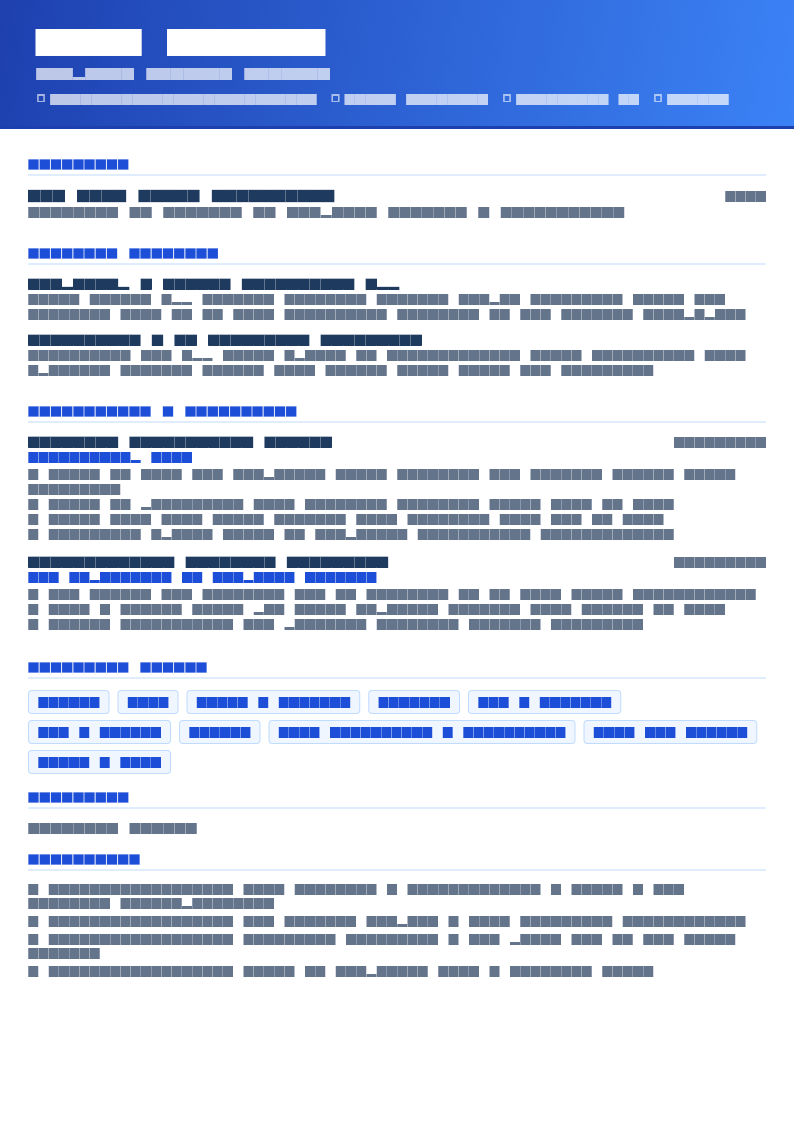
Campus Placement resume template
Campus Placement is built for Indian campus recruitment: education and CGPA prominent near the top, a proper projects block, and everything on one page. ATS 94, free, watermark-free PDF export.
Use this template in NextCV| Template | ATS score | Price | Best for |
|---|---|---|---|
| Campus Placement | 94 | Free | Campus placement drives and fresher applications |
| Graduate ATS | 92 | Premium | Graduates with internships and a strong final-year project |
| ATS Pro | 98 | Free | Large service-company portals where parsing safety matters most |
| Software Engineer ATS | 96 | Free | Software roles with a longer technical stack to present |
| Undergraduate Classic | 88 | Premium | Undergraduates wanting a conventional academic-style layout |
Checklist
- One page, single column, text-based PDF
- CGPA or percentage visible in the education block, with backlog status if clean
- Class XII and X results included
- Objective contains at least one concrete fact
- Two or three projects with stack, scale and a real number
- Your own contribution named on every group project
- Internships written as work, not as company descriptions
- Skills grouped, with a concepts line instead of a syllabus paragraph
- Positions of responsibility include budget, headcount or attendance
- GitHub link survives a click
- Declaration included only if your process expects it
- No photo, date of birth, father’s name or marital status
Frequently asked questions
What is the best resume format for freshers?
One page, single column, reverse-chronological, with this order: header, objective or summary, education, technical skills, projects, internships, certifications, positions of responsibility, and a declaration only if your institution expects one.
Education comes high because your degree and CGPA are the first screening filters in campus recruitment. Projects come next, because they are the only evidence of what you can actually do.
Should a fresher resume mention CGPA or percentage?
Yes. In Indian campus recruitment, CGPA or percentage is a standard shortlisting filter and many companies publish a cut-off, so omitting it can get you filtered out by default.
State it the way your institution reports it — “8.4/10 CGPA” or “78%” — and include Class XII and Class X results while you are still a fresher, since many recruiters screen on those too.
Is a declaration necessary on a fresher resume?
It is a convention rather than a requirement. Many Indian colleges still teach it and some campus processes expect it, so include a single line if yours does. For applications to product companies, startups and international employers it adds nothing and can be dropped.
If you include it, keep it to one line at the end with your name and city. There is no need for a signature image.
How many projects should a fresher resume have?
Two or three, described properly, rather than five listed by title. Each should name what you built, the stack, and a concrete outcome — records handled, users, accuracy, latency, or a measurable improvement.
One finished project with real users outperforms four tutorial clones. If a project is a well-known tutorial, either add something substantial of your own to it or leave it out.
Should freshers include a photo on the resume?
It is optional in India and increasingly omitted. Nothing is gained by including it, some parsers handle image-heavy documents badly, and for international applications a photo is a liability.
If your campus placement cell explicitly requires a photo on a standard form, follow their format for that submission and keep a clean version for everything else.
How do freshers write experience with no job history?
Use projects, internships, industrial training, workshops and positions of responsibility as your experience. Write each with the same structure as a job: what you did, at what scale, and what the result was.
A final-year project handling 50,000 records, an internship where you automated a report, or a technical fest you organised for 400 attendees are all legitimate, checkable evidence.
NextCV Editorial
NextCV is an AI resume builder by Empire Softtech. We publish the same guidance our in-app ATS analyser is built on — seven weighted sections, 29 templates scored from 72 to 98, and no formatting advice we would not follow ourselves.