
Step 0: gather your material before you write a word
The reason resume writing feels awful is that most people try to remember, decide and phrase all at once. Separate those jobs and it becomes straightforward.
Open a blank document and spend twenty minutes collecting raw facts. No sentences, no polish, just material:
- Employment dates. Month and year for every role, from your payslips, contracts or LinkedIn — not from memory. Duration filters in recruiting systems compute your years of experience from these, so approximations cost you.
- Exact job titles, plus the industry-standard equivalent if your official title was unusual.
- Numbers. Anything you can substantiate: team sizes, budgets, volumes, percentages, before-and-after figures, customer or patient counts, timescales. Dig through old performance reviews, dashboards and handover documents. This is the single highest-value twenty minutes of the whole exercise.
- Qualifications with institution, completion year, and — for licences and certifications — the issuing body and expiry date.
- One target job posting that represents the kind of role you want. You will write against it.
A resume written in the abstract is a resume written for nobody. Having one real posting open while you draft keeps you honest about which of your experience is actually relevant, and it gives you the employer's own vocabulary to borrow.
The seven sections, in the order recruiters read them
A resume is not a creative document. It has a conventional structure, and departing from it costs you both in automated parsing and in human skim-reading. Here is the order, and how it shifts with career stage:
| Order | Under 2 years / student | 2–10 years | 10+ years / senior |
|---|---|---|---|
| 1 | Contact | Contact | Contact |
| 2 | Professional summary | Professional summary | Professional summary |
| 3 | Skills | Skills | Skills |
| 4 | Education | Work experience | Work experience |
| 5 | Projects | Education | Education |
| 6 | Work experience / internships | Certifications | Certifications, publications, boards |
| 7 | Certifications, activities | Projects (optional) | — |
The one structural rule underneath all of that: put your strongest evidence in the top third of page one. For a student that is education and projects. For an experienced professional it is work experience. For a nurse or a lawyer it is licensure. Everything else follows.
Step 1: contact details
Four lines, no decoration, and — importantly — inside the body of the document rather than in the page header region, which some parsers skip entirely.
Priya Nair
Bengaluru, Karnataka · +91 98XXX XXXXX · priya.nair@email.com
linkedin.com/in/priyanair · github.com/priyanair
Write URLs as visible plain text. If you hyperlink the words "my portfolio", text extraction keeps the words and loses the address. Use a professional email address — firstname.lastname is fine, a nickname from 2009 is not. Include a country code if you are applying internationally.
Leave off: full street address, date of birth, marital status, nationality, and a photo (unless the market you are applying to expects one).
Step 2: the professional summary
Three or four lines directly under your name. Not an objective statement about what you want — a compressed statement of what you are.
Generic
Hardworking and detail-oriented professional seeking a challenging position with a reputable organisation where I can utilise my skills and grow.
Specific
Operations manager with 8 years in third-party logistics, currently running a 60-person warehouse handling 14,000 outbound units a day. Cut pick error rate 31% in 18 months by redesigning the zone layout.
The pattern that works: [role and level] + [years and domain] + [scale figure] + [one piece of ownership evidence]. If your summary could be pasted onto 500 other applications without changing a word, it is doing nothing for you. Put a number in the first two lines.
This is also the section you rewrite for every application — it is four lines of editing for a disproportionate return. There are 25 worked examples in our resume summary examples guide.
Step 3: work experience (where most of the value is)
Reverse chronological — newest first. For each role: title, employer, location, and dates in one consistent format. Then bullets.
Every bullet follows the same shape: past-tense verb + what you did it to + what changed as a result. If there is no result, you have written a job description rather than an achievement, and job descriptions are why recruiters skim.
Responsibility
Responsible for managing the client onboarding process and maintaining internal documentation.
Achievement
Rebuilt client onboarding into a seven-step checklist, cutting average time-to-first-invoice from 21 days to 9 across 60 accounts.
Practical rules:
- Three to five bullets for your current role, two or three for the previous one, one or two for anything older than five years. Weight space by relevance, not by how long you were there.
- Lead with a strong verb. Retire helped, worked on, was responsible for, assisted with, participated in. Our resume action verbs list has 200-plus alternatives grouped by what they actually mean.
- Quantify with whatever you have. You do not need revenue. Volume, frequency, headcount, budget, error rates, cycle times, satisfaction scores and before/after comparisons all work.
- Never invent a number. Everything on the page is a potential interview question. Use a count or a range you can defend.
- One or two lines per bullet. A four-line bullet is a paragraph in disguise and will not be read.


Step 4: skills
Group them by category rather than dumping one long comma-separated line, and put the technologies or competencies named in your target posting first. Four to six categories, six to ten items each, all of them things you would accept an interview question on.
- Technical: SQL, Python, Power BI, Excel (Power Query, pivot models), dbt
- Operations: demand forecasting, inventory planning, S&OP cycles, vendor management
- Systems: SAP S/4HANA, Oracle NetSuite, Jira, Confluence
- Certifications: Lean Six Sigma Green Belt, APICS CPIM (in progress)
What not to do: skill rating bars, star ratings and percentage dials. They contain no extractable text, they mean different things to different readers, and nobody has ever known what four out of five stars in Excel represents. See resume skills for role-by-role lists.
Step 5: education
Degree, institution, location, completion year. That is the whole entry for most people once they have professional experience.
Add more only when it earns its space: relevant coursework if you are a recent graduate applying to a role that maps to it, a dissertation or capstone if it demonstrates applicable skill, and academic honours if they are genuinely notable. Include your grade only if it is strong or if the employer asks — many graduate schemes and campus processes do. Once you have five years of experience, education drops below work experience and shrinks to two lines.
Step 6: certifications, projects and the optional extras
Certifications get the issuing body and the expiry or completion date, so nobody has to guess whether yours is current: AWS Solutions Architect – Associate, Amazon Web Services, valid to 03/2028. In regulated fields — nursing, teaching, law, accounting, aviation — this section moves up near the top, because it is a screening criterion rather than a bonus.
Projects are compulsory for students and career changers, optional for everyone else. The test after two years of professional experience: does this project show something my paid work does not? If yes, include it with an outcome. If it is a tutorial you followed, leave it out.
Genuinely optional, in rough order of usefulness: publications and talks, professional memberships, volunteering with real responsibility, languages with an honest proficiency level. Skip: hobbies with no bearing on the work, "references available on request" (assumed), and a declaration or signature line unless a specific national convention requires it.
Step 7: tailor it to one job
This is the step people skip, and it is the one that changes outcomes. Open your target posting next to your draft and do four things:
- List the hard requirements the posting names — tools, certifications, methodologies, domain terms.
- Check each one appears in your resume if you genuinely have it, phrased the way the employer phrased it. If the posting says "revenue cycle management" and you wrote "billing operations", change yours.
- Reorder your skills so the posting's terms come first in each category. Same facts, better match.
- Rewrite the summary to name the role you are applying for and lead with the most relevant evidence you have.
Ten minutes, and it is what moves you up a keyword search. What tailoring is not: adding skills you do not have, inflating a title, or pasting the job description into your document in white text. All three are found immediately and all three end the application.
Formatting and export
Structure carries most of the risk of your resume being misread by software, so keep it dull:
- Single column. Two-column and sidebar layouts are the most common cause of scrambled text extraction, because the reading order interleaves the sidebar with your experience.
- No tables, text boxes or content in the page header and footer.
- No text inside images, including logo grids and skill charts.
- Conventional headings: Professional Summary, Work Experience, Skills, Education, Certifications. Not "My Journey" or "Superpowers".
- 10–12 pt body text, one typeface, margins of at least 1.5 cm, and real white space between sections.
- Export a text-based PDF named
Firstname-Lastname-Role.pdf. Never a scanned or image-only PDF — it contains no extractable text at all.
The full set of parsing rules is in ATS resume tips, and the layout options are compared in resume format.
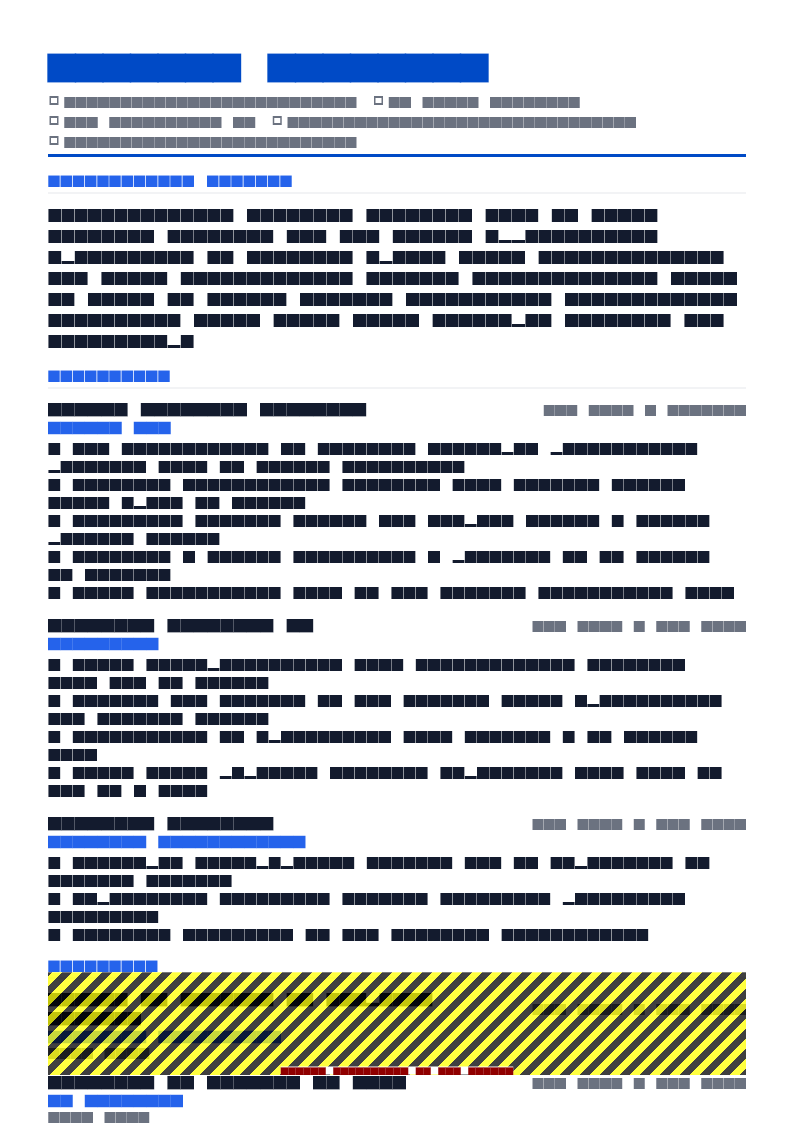
ATS Pro resume template
If you are writing your first resume and do not want to think about layout risk at all, start here. ATS Pro is the highest-parsing layout in the NextCV library: single column, conventional headings, and nothing that trips text extraction.
Use this template in NextCVCheck it before you send it
Two checks, both cheap. First, the plain-text test: open your PDF, select all, copy, and paste into a plain text editor. Are the section headings still on their own lines? Do employer, title and dates still sit together? Is your phone number present? If the paste looks shuffled, software sees the same shuffle — fix the layout, not the wording.
Second, a scoring pass. The NextCV analyser weights seven sections — work experience 30%, skills 20%, summary 15%, personal information 10%, education 10%, projects 10%, certifications 5% — and reports a score out of 100 with bands at 0–40 poor, 41–60 average, 61–80 good and 81–100 excellent. The weighting is the useful part: it tells you that rewriting three experience bullets is worth more than perfecting your certifications block. Details in the ATS score guide.


Final checklist
- Contact block complete, in the document body, with plain-text URLs
- Summary is three to four lines and names the target role
- Every role has consistent
MM/YYYYdates and a recognisable job title - Recent roles have three to five bullets; each bullet ends in a result
- At least four different kinds of number used across the resume
- Skills grouped by category, with the posting's terms first
- Certifications carry issuing body and expiry or completion date
- Gaps longer than a few months labelled with dates
- Single column, no tables, no skill bars, nothing in the page header
- Exported as a text-based PDF named
Firstname-Lastname-Role.pdf - Plain-text paste test passed
- Application form questions answered accurately — that is where real auto-rejections happen
Frequently asked questions
How long should it take to write a resume?
Budget about 90 minutes for a first complete version if you have your dates, figures and job titles to hand. Most of that time goes on the experience bullets, which is the right place to spend it.
After the first version exists, each application should take ten minutes: rewrite the summary, reorder the skills, adjust two or three bullets to match the posting's vocabulary.
Should I write my resume from scratch or start from a template?
Start from a template for the structure, but write the content in a plain document first. Templates make people write to fit the box — three bullets because there are three bullet slots — rather than writing what is true and then choosing a layout that fits.
Draft your bullets as plain text, then paste them in. You will write better and cut more.
What if I have employment gaps?
Label them and move on. A single dated line, such as "Career break — full-time caregiving, 05/2024 – 02/2025", costs you far less than an unexplained hole that a recruiter has to guess about.
Do not try to hide a gap by removing dates or switching to a functional format. Both read as concealment and neither survives an interview.
Do I need a different resume for every job?
You need one master resume and a short tailoring pass per application. Rewrite the summary, reorder your skills so the posting's own terms come first, and adjust a few bullets to use the employer's vocabulary.
That is enough to move you up a recruiter's keyword search without maintaining a dozen separate documents.
Should I include a photo, date of birth or full address?
In the US, UK, Canada, Australia and Ireland: no to all three. Photos invite bias claims and many employers strip them; date of birth and marital status are irrelevant; a full street address is unnecessary when city and region will do.
Photos remain conventional in parts of continental Europe, Latin America and Asia, so follow the norm of the market you are applying in.
Is one page still the rule?
One page up to roughly ten years of relevant experience, two pages after that. Clinical, academic and senior technical roles routinely need more because licences, publications and architecture ownership are the substance of the qualification.
Never compress two pages into one by dropping to 8 pt type and killing the margins. A dense, unreadable page performs worse than a clean second page.
NextCV Editorial
NextCV is an AI resume builder by Empire Softtech. We publish the same guidance our in-app ATS analyser is built on — seven weighted sections, 29 templates scored from 72 to 98, and no formatting advice we would not follow ourselves.