
The designer’s dilemma, stated plainly
Every designer has been told two contradictory things: your resume should demonstrate your design ability, and your resume must be machine-readable.
Both are true, and they genuinely conflict. The layouts that show typographic control — asymmetric grids, sidebars, colour-blocked sections, type set in images — are precisely the ones that scramble text extraction. A recruiter searching a requisition for “design system” will not find you if your skills section parsed as a fragment.
The mistake is trying to resolve the conflict inside one file. You cannot, and the attempt produces a document that is neither a good portfolio piece nor a reliable data document.
Two files, two jobs. A plain single-column resume for portal uploads, whose only job is to parse cleanly and get you to a portfolio review. A designed version for direct emails to hiring managers and for your own site, where a human opens it and craft is the point.
Nobody has ever been rejected for a resume that was too readable.
The two-document system in practice
| Application version | Designed version | |
|---|---|---|
| Used for | Portal uploads, recruiter submissions, agency applications | Direct email to a hiring manager, your own site, networking |
| Layout | Single column, conventional headings | Whatever serves the work |
| Typography | One safe embedded typeface, 10–12 pt body | Your choice, embedded |
| Graphics | None containing text | As appropriate |
| File | Text-based PDF | PDF, or a page on your site |
| Judged on | Whether it parses and matches | Craft, taste, hierarchy |
Maintain the same content in both so nothing contradicts. The only difference should be presentation.
Section order
- Contact — including the portfolio URL as visible plain text
- Summary — discipline, years, domain, scope, portfolio
- Skills and tools — grouped; searched heavily in design recruitment
- Experience — outcome-based bullets
- Selected projects — two or three, if freelance or early career
- Education and certifications
The summary
Craft claims only
Creative and passionate graphic designer with a keen eye for detail and a strong sense of aesthetics, experienced across branding, print and digital design.
Scope and evidence
Product designer with 6 years on data-heavy B2B tools, currently owning end-to-end design for a scheduling product used by 12,000 field technicians. Built and maintain a 60-component design system adopted by 4 squads. Portfolio: yourname.design
“Keen eye for detail” is a claim your portfolio either supports or contradicts within four seconds, so asserting it in text is wasted. Spend the words on discipline, domain, scale and systems ownership — the things a portfolio cannot tell a recruiter at a glance.
Portfolio link rules
The portfolio is the document that gets you hired. The resume exists to get it opened. Four rules follow:
- Write the URL as visible plain text.
yourname.design, not a hyperlink behind the words “view my work”. Text extraction keeps what is visible, and recruiters copy URLs out of parsed text. - Avoid passwords where you can. Every barrier loses candidates in the pipeline. If confidentiality requires it, put two or three open pieces on the landing page and gate only the sensitive case studies, with the password in your application.
- Reorder the landing page per application. The first three projects a visitor sees should be the ones closest to the role. Reviewers rarely scroll past three.
- Include process, not just outcomes. Hiring managers are assessing how you think. Two or three case studies showing the problem, what you tried and what you learned beat twelve polished final frames.
One more: check the link before every application. A dead portfolio URL on an otherwise strong resume is the most avoidable rejection in the field.
Outcome-based bullets
Designers under-quantify more than any other discipline, usually because the numbers feel like someone else’s. They are not — there are numbers that are specifically yours.
Activity
Responsible for creating visual assets for marketing campaigns, social media and the company website, working closely with the marketing team.
Outcome
Redesigned the job-dispatch flow after 18 field observation sessions, cutting average task completion from 4m 20s to 1m 50s in usability testing with 12 technicians.
- Introduced a 60-component design system across 4 squads, removing 3 conflicting button patterns and cutting design-to-build handoff queries by roughly half.
- Brought 4 public-sector sites to WCAG 2.2 AA, resolving 214 issues and passing external audit with no critical findings.
- Rebranded a 40-product range across packaging, print and digital in 5 months, delivering 180 assets and a 24-page brand guideline now used by 3 agencies.
- Cut Largest Contentful Paint from 4.1s to 1.6s on the marketing site by rebuilding the hero component and moving to a system typeface stack.
Notice what those have in common: each one names a craft decision and a measured consequence. Neither alone would work — a decision without an outcome is activity, and an outcome without the decision could belong to anyone on the team.


The design metric menu
| Dimension | What to cite |
|---|---|
| Reach and scale | Users, monthly actives, impressions, print run, markets, locales, products or SKUs covered |
| Systems work | Components built, teams or squads adopting, patterns consolidated, tokens defined, documentation pages |
| Usability | Task completion time and rate, error rate, SUS score, sessions run, participants recruited |
| Accessibility | Conformance level reached, issues resolved, audit outcome, assistive-technology testing |
| Performance | Core Web Vitals, bundle or asset weight reduced, image payload, render-blocking resources removed |
| Business (shared credit) | Conversion, sign-up rate, support contacts reduced, churn — described as contribution, not sole ownership |
| Throughput | Assets delivered, campaigns shipped, average turnaround, concurrent projects, stakeholders managed |
Prefer the design-owned metrics over the business ones. “Task completion fell from 4m 20s to 1m 50s in testing” is unambiguously your work; “increased revenue 20%” invites the question of what else changed that quarter. If you cite a business figure, say “contributed to” and name your part.
Tools and craft skills
- Product & UX: user research, usability testing, journey mapping, information architecture, wireframing, prototyping, design systems
- Visual: typography, layout, colour, brand identity, iconography, illustration, print production and prepress
- Accessibility: WCAG 2.2 AA, colour contrast, focus order, screen-reader testing (VoiceOver, NVDA)
- Tools: Figma (variables, auto-layout, component libraries), Adobe Illustrator, Photoshop, InDesign, After Effects
- Build-adjacent: HTML/CSS handoff, design tokens, component documentation, responsive and fluid layout
- Collaboration: design critique facilitation, stakeholder workshops, engineering pairing, Jira and Storybook
Two notes. Never use rating bars — they contain no extractable text, so a parser sees an empty skills section, and self-rating 3/5 in Figma at the top of a design resume is an own goal. And the build-adjacent line matters more than designers expect: evidence that you hand off cleanly and understand implementation constraints is one of the strongest differentiators in product design hiring. Full lists in resume skills.
Brand, product, motion and production
| Role | Lead with | Typical bullet shape |
|---|---|---|
| Product / UX designer | Users, research volume, systems work, measured usability change | Ran 18 field sessions and redesigned the dispatch flow, cutting task time from 4m 20s to 1m 50s. |
| Brand / identity designer | Range covered, guidelines produced, rollout scope, agencies briefed | Rebranded a 40-product range across packaging and digital, delivering 180 assets and a 24-page guideline. |
| Marketing / campaign designer | Campaigns shipped, channels, throughput, performance contribution | Delivered 22 campaigns across paid, email and social; the redesigned landing template lifted sign-up conversion 17%. |
| Motion designer | Runtime delivered, formats, turnaround, engagement | Produced 34 short-form assets across 5 aspect ratios with a 3-day average turnaround. |
| Production / artwork | Volume, accuracy, print specification, prepress | Prepared 1,400 artwork files a year across 9 print specifications with zero reprint errors. |
| Design systems | Components, adopting teams, consistency gains, contribution model | Grew a system from 12 to 60 components with 4 squads contributing under a documented review process. |
| Design lead / manager | Team size, hiring, process, portfolio of work overseen | Led 5 designers across 3 product areas; introduced weekly critique and cut design rework by roughly a third. |
Junior designers and career changers
With no professional design history, the resume has one job: get the portfolio opened. Three things make that happen.
Real constraints. Speculative redesigns of famous apps are the most common junior portfolio piece and the least persuasive, because no constraint was involved. Work with an actual client — a local business, a charity, a society, a friend’s side project — where someone had an opinion, a budget and a deadline. One of those beats five self-directed concepts.
Process visible. Junior portfolios that show only finished frames give a reviewer nothing to assess. Show the brief, two directions you rejected and why, and what changed after feedback.
Craft fundamentals stated. Typography, grid, hierarchy and accessibility are what juniors are actually screened on. Name them in your skills block and demonstrate them in the resume itself — for a designer, the document is a work sample regardless of how plain you keep it.
If you are moving from an adjacent field, the hybrid structure in career change resume applies: skills and projects above your dated history.
Templates
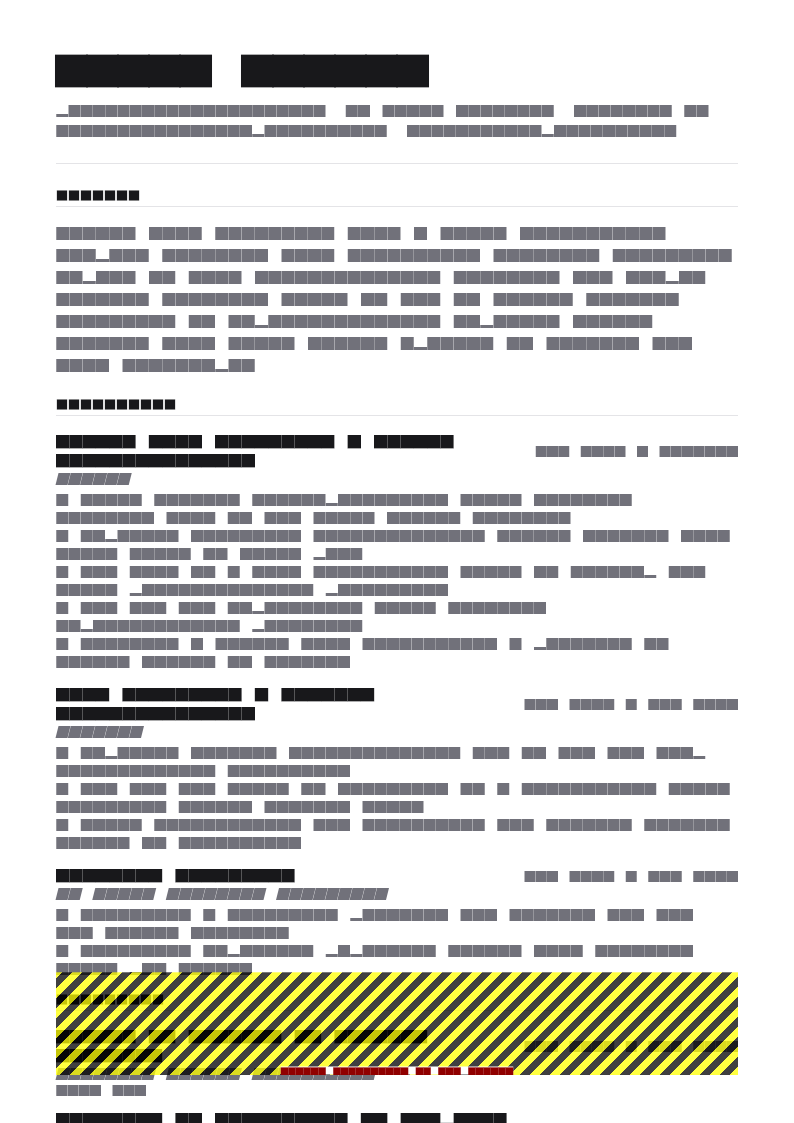
Pure White resume template
For the application version, Pure White is the natural designer’s choice: restrained, typography-led, single column, and it parses at 95. It looks deliberate rather than undesigned — which matters when the reader is judging your taste.
Use this template in NextCV| Template | ATS score | Price | Best for |
|---|---|---|---|
| Pure White | 95 | Free | Application version — minimal and typography-led |
| ATS Pro | 98 | Free | Application version — maximum parsing safety for strict portals |
| Ink & Type | 75 | Free | Designed version — typographic character, direct email only |
| Design Portfolio | 80 | Premium | Designed version — portfolio-oriented, direct email only |
| Portfolio Showcase | 72 | Premium | Designed version — strongest visual presence, never for portals |
The pattern in those scores is the whole argument for the two-document system: the layouts that show the most craft parse the worst. Use both, for different purposes.
Checklist
- Two versions maintained: plain for portals, designed for direct contact
- Application version is single column with no text inside images
- Portfolio URL written as visible plain text, and checked before sending
- Portfolio landing page reordered so the top three pieces fit the role
- At least two case studies show process, not just final frames
- Bullets pair a craft decision with a measured consequence
- Design-owned metrics preferred over business metrics
- Shared-credit business figures described as contribution
- Systems work quantified: components, adopting teams, patterns removed
- Accessibility experience stated with a conformance level
- No skill rating bars anywhere
- One page, text-based PDF, fonts embedded
Frequently asked questions
Should a graphic designer resume be creative or plain?
Plain for anything you upload to an application portal, and designed for anything you send directly to a human. Multi-column layouts, text inside images and heavy graphics are the most common cause of scrambled text extraction, and a designer whose experience section fails to parse is invisible to a recruiter search.
This is not a compromise on craft. Your portfolio is where craft is judged; the resume is a data document.
Do designers need a portfolio and a resume?
Yes, and the portfolio matters more. Almost no design hire happens on the strength of a resume — the resume gets you to the portfolio review. Treat it as the qualifying document rather than the pitch.
Put the portfolio URL in your contact block as visible plain text, and make sure the first three projects a visitor sees are the ones most relevant to the role you are applying for.
How do I quantify design work?
Reach and scale (users, impressions, print run, markets, locales), system work (components built, teams adopting it, inconsistencies removed), measured outcomes (task completion, conversion, support contacts, accessibility conformance) and throughput (assets delivered, turnaround, campaigns shipped).
You do not have to claim credit for revenue. “Cut average task completion from 4m 20s to 1m 50s in usability testing” is a designer's number and it is more credible than a business metric you did not own.
Should I put my portfolio behind a password?
Avoid it if you can. Every barrier between a reviewer and your work loses you candidates in the pipeline, and hiring managers reviewing dozens of applications will not request access.
If client confidentiality requires protection, put two or three publicly viewable pieces on the landing page and gate only the sensitive case studies, with the password stated in your application.
What should a designer leave off a resume?
Skill rating bars and star ratings for software (no extractable text, no shared meaning), a photo in most English-speaking markets, and decorative typography that fails when a font substitutes.
Also leave off the design itself as a substitute for content. A beautifully typeset page that only says “responsible for creating visual assets” loses to a plain page with outcomes.
How long should a designer resume be?
One page for most designers, two only for design leadership with a substantial team and systems history. Your portfolio carries the depth, so the resume can stay tight.
Use the space for outcomes and systems work rather than listing every tool in the Adobe suite.
NextCV Editorial
NextCV is an AI resume builder by Empire Softtech. We publish the same guidance our in-app ATS analyser is built on — seven weighted sections, 29 templates scored from 72 to 98, and no formatting advice we would not follow ourselves.