
Tier 1: mistakes that make you invisible
These do not cause rejection. They cause you never to be considered, which is worse because you get no signal at all.
1. A multi-column layout on a portal upload
Text extraction reads a document in order. A sidebar layout interleaves your skills with your employment, producing parsed records like “Skills Senior Engineer Python Acme Corp SQL 2022”. A recruiter filtering the requisition never sees you, because the fields they search are full of fragments. This is the single most common serious error, and it is invisible from your side.
2. Contact details in the page header region
Some parsers skip page headers and footers entirely. Putting your phone number and email there is a good way to be shortlisted and then uncontactable. Keep the whole contact block in the body of the document.
3. A scanned or image-only PDF
A photograph of a printed resume, or a design-tool export flattened to a single image, has no text layer. Unless the employer runs OCR, the parse result is an empty document. The same applies to putting your skills inside a graphic.
4. Creative section headings
Parsers segment your resume by matching headings against a known vocabulary. “My Journey”, “Where I’ve Made an Impact” and “Superpowers” are not in that vocabulary, so everything underneath gets filed as unclassified text. Use Professional Summary, Work Experience, Skills, Education, Certifications.
5. Inconsistent or missing dates
Requirement filters compute your years of experience by subtracting dates. Mixing “2023-24” with “March 2024 to now”, or omitting months, makes that calculation unreliable — so you fail a “3+ years” filter while having six. Pick one format such as MM/YYYY and use it everywhere.
Open your exported PDF, select all, copy, and paste into a plain text editor. If the section headings are on their own lines, employer/title/dates sit together, your phone number is present, and nothing is interleaved, you have passed. If the paste looks shuffled, software sees the same shuffle.
Tier 2: mistakes that stop the reader
You are visible, a human has opened the file, and now you lose them.
6. Duty-based bullets instead of achievements
The most widespread substantive error on resumes. A bullet with no result is a job description, and every applicant with your title has the same one.
Duty
Responsible for managing the client onboarding process and maintaining internal documentation.
Achievement
Rebuilt client onboarding into a seven-step checklist, cutting average time-to-first-invoice from 21 days to 9 across 60 accounts.
7. A summary that could belong to anyone
“Results-driven professional with excellent communication skills seeking a challenging role.” Four lines in the most valuable position on the page, saying nothing. If 500 other applicants could send your summary unchanged, replace it — a number in the first two lines usually fixes it. See resume summary examples.
8. No numbers anywhere
Without scale, a reader cannot place you. Were you supporting a team of three or three hundred, a £50k budget or £5M? You do not need revenue figures — volume, headcount, frequency, error rates, cycle times and before/after comparisons all work.
9. Soft-skill lists
“Team player, detail-oriented, hardworking, adaptable.” Unverifiable when asserted, and claimed by everybody. Move them into bullets where the evidence lives: “wrote the handover documentation now used by 40 staff across three shifts” demonstrates communication without claiming it.
10. Skill rating bars and percentage dials
Three separate problems: no extractable text, no shared meaning, and rating yourself 3/5 in the posting’s headline requirement is an argument against your own application, rendered as a graphic, near the top of the page.
11. Unexplained gaps
Recruiters do not penalise explained gaps nearly as much as they puzzle over unexplained ones. One dated line — Career break — full-time caregiving, 05/2024 – 02/2025 — closes the question entirely.
12. Every role weighted equally
Five bullets on a role from 2013 and two on your current one inverts your own relevance. Three to five bullets for the current role, two or three for the previous, one or two for older ones, a single line for anything ancient and unrelated.


Tier 3: mistakes that quietly cost you
13. Sending the same resume everywhere
Untailored applications are the highest-volume, lowest-yield job search strategy available. Ten minutes per application — rewrite the summary, reorder skills so the posting’s terms come first, adjust two or three bullets — beats sixty untailored submissions.
14. Unrecognisable job titles
If your employer called you a “Growth Ninja” or “Member of Technical Staff III”, nobody is searching for that. Lead with the industry-standard equivalent and keep the official title in brackets where accuracy requires it. Clarifying is fine; promoting yourself a level is not.
15. Hyperlinked words instead of visible URLs
Extraction keeps what is visible. Write linkedin.com/in/yourname rather than hiding the address behind “my profile”.
16. An empty or abandoned GitHub or portfolio link
Worse than no link. An interested reviewer clicks it and now knows more than they did — that there is nothing there. Link only what stands up to a click.
17. Unlabelled acronyms
You do not know which form the recruiter typed into the search box. Write it out once alongside the short form: Continuous Integration / Continuous Deployment (CI/CD), Advanced Cardiac Life Support (ACLS).
18. Padding, in either direction
A two-page resume with one page of content reads as thin. A one-page resume achieved with 8 pt type and 1 cm margins reads as desperate and gets skipped. Length should follow substance: cut old roles and duty bullets, or add the second page.
Tier 4: mistakes that read as careless
19. A pattern of typos, and the high-risk ones specifically
One typo rarely ends an application. A pattern does, because it stops being about spelling. The genuinely damaging versions: a misspelled employer or product name, a summary still naming the company you applied to last week, and mismatched dates between your resume and your LinkedIn profile.
20. Inconsistent formatting
Dates right-aligned in one role and inline in the next. Some bullets ending in full stops and some not. Two typefaces because content was pasted from an old document. Individually trivial, collectively the clearest signal available that the document was assembled in a hurry.
21. Details nobody asked for
Date of birth, marital status, nationality, full street address, a photo (in the US, UK, Canada, Australia and Ireland), hobbies with no bearing on the work, and “references available on request” — which is assumed and uses a line.
Hidden white-text keywords. Extraction strips styling and keeps the words, so the recruiter sees your keyword dump in the parsed text. It reads as dishonest and gets candidates flagged in employer databases.
Fabricated dates, titles or qualifications. Background checks and reference calls find these routinely, and discovery after hiring is usually terminal. Everything on the page should be something you would be content to have verified.
Three things widely called mistakes that are not
- A two-page resume, if you have the experience. Beyond ten years, compressing to one page means deleting the evidence that supports your level. Clinical and academic documents run longer still.
- Colour and typography. Design does not break parsing; structure does. A clean single-column layout with an accent colour and confident type is fine and reads better than an undesigned one.
- Including a part-time or unrelated job. Retail and hospitality work demonstrates reliability, volume handling and training others. Write it with results and give it one or two bullets.
A 15-minute self-audit
- Paste test (2 min). PDF → select all → copy → plain text editor. Check headings, dates, contact details and reading order.
- Bullet count (3 min). Count bullets that end in a measurable result. Under half? That is your evening’s work.
- Summary test (1 min). Could 500 other applicants send it unchanged? Rewrite with a number.
- Date sweep (2 min). One format everywhere; every gap over three months labelled.
- Posting cross-check (5 min). Open the job ad. Every hard requirement you genuinely meet should be findable in your resume text with a search.
- Score it (2 min). Run the ATS analyser — work experience 30%, skills 20%, summary 15% — and fix the heaviest section first.
The full mechanical rules behind step 1 are in ATS resume tips.
Templates that prevent the Tier 1 mistakes
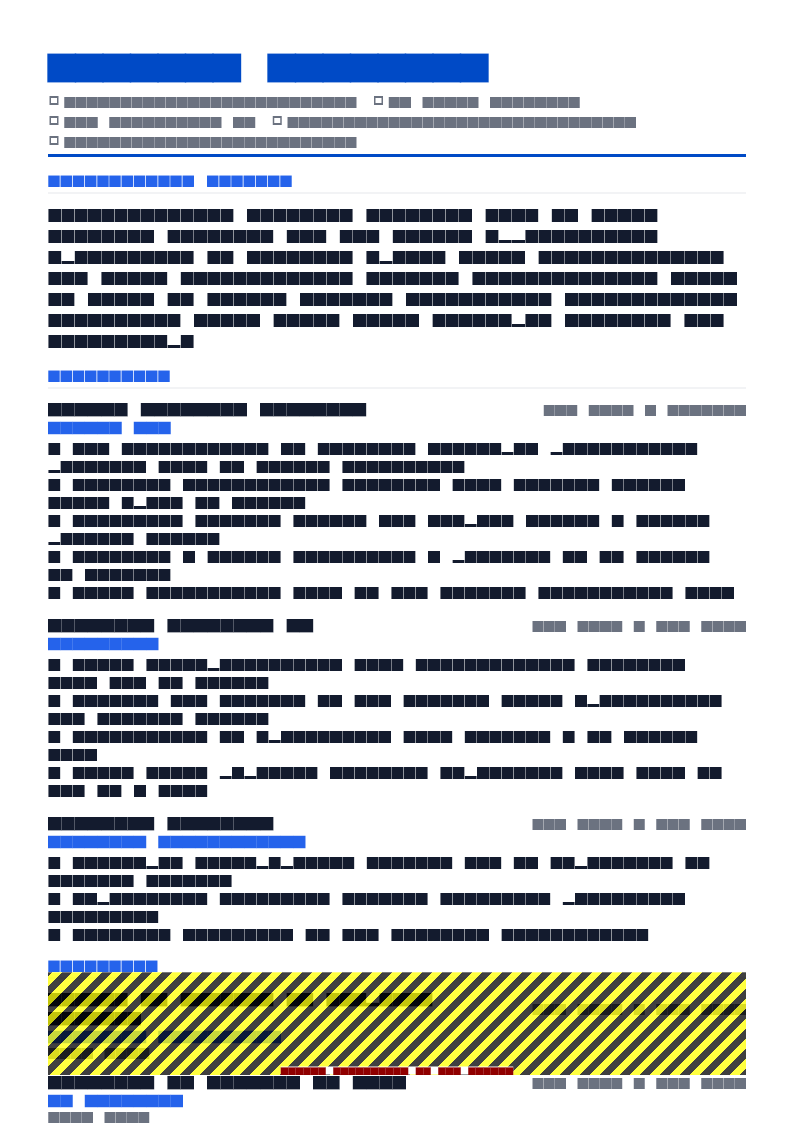
ATS Pro resume template
ATS Pro is single column with conventional headings and nothing in the page header region, which removes four of the five Tier 1 mistakes by construction. Highest-parsing layout in the library at 98, free.
Use this template in NextCV| Template | ATS score | Price | Best for |
|---|---|---|---|
| ATS Pro | 98 | Free | Maximum parsing safety — the default recommendation |
| Pure White | 95 | Free | Minimal and typography-led, generous white space |
| Software Engineer ATS | 96 | Free | Technical roles with a long stack list to present |
| Executive Classic | 90 | Free | Senior and executive histories across two pages |
Checklist
- Single column; nothing in the page header or footer
- Text-based PDF, not a scan or a flattened image
- Conventional section headings
- One date format throughout; every role dated
- Over half your bullets end in a measurable result
- Summary contains a number and names the target role
- No soft-skill list, no skill rating bars
- Gaps over three months labelled
- Job titles recognisable; internal titles in brackets
- URLs written as visible plain text; every link survives a click
- Acronyms spelled out once alongside the short form
- Consistent alignment, punctuation and typeface
- No photo, date of birth, marital status or full address
- Nothing on the page you would not want verified
Frequently asked questions
What is the biggest mistake on a resume?
Bullets that describe duties instead of results. “Responsible for managing the onboarding process” tells a reader what you were assigned; it says nothing about whether you were any good at it.
The structural equivalent, and just as damaging, is a multi-column layout for a portal upload — it can scramble text extraction so badly that your experience never reaches the fields a recruiter searches.
Do typos really cost you the job?
A single typo rarely ends an application on its own. A pattern of them does, because it stops being about spelling and starts being evidence about how you work.
The higher-risk versions are a misspelled employer or product name, an inconsistent date format, and a summary still naming the company you applied to last week.
Is it a mistake to use a resume template with graphics?
For anything you upload to a portal, yes. Graphics contain no extractable text and multi-column layouts break reading order, so the parsed record can lose your entire skills or experience section.
Keep a single-column version as your application document. A designed version is fine for your own site or a direct email to a hiring manager.
Should I include every job I have ever had?
Include a complete recent history so there are no unexplained gaps, but compress what is not relevant. Roles from more than fifteen years ago, or in an unrelated field, can be a single line of title, employer and dates.
The mistake in both directions: hiding jobs creates gaps that invite questions, while giving every role five bullets buries what matters.
Is a two-page resume a mistake?
Not beyond about ten years of experience — and in clinical, academic and senior technical roles a second page is expected. The mistake is a two-page resume with one page of content, or a one-page resume achieved with 8 pt type and 1 cm margins.
Length should follow substance. If you are padding, cut instead; if you are compressing, add the page.
What should never go on a resume?
Patient or client identifying information, confidential figures your employer would not publish, hidden white-text keywords, fabricated dates or titles, and a full salary history nobody asked for.
Also drop: date of birth, marital status, a photo (in most English-speaking markets), full street address, and “references available on request”, which is assumed.
NextCV Editorial
NextCV is an AI resume builder by Empire Softtech. We publish the same guidance our in-app ATS analyser is built on — seven weighted sections, 29 templates scored from 72 to 98, and no formatting advice we would not follow ourselves.