
Why a nursing resume is a different document
In most fields, a recruiter is assessing whether you are good. In nursing, they are first establishing whether you are eligible.
Before anyone considers your judgement or your bedside manner, a nurse recruiter has to confirm four hard facts: you hold the right licence in the right jurisdiction, it is current, you have the required certifications, and you have worked the unit type the vacancy is on. Those are gating conditions, and they are typically what gets typed into the search box — RN AND ICU AND CCRN, filtered to a state or a compact licence.
Three consequences follow, and they explain every structural difference from a standard resume:
- Credentials move to the top. Licensure and certifications sit above work experience, because they are screening criteria rather than nice-to-haves.
- Context is part of the achievement. "Cared for post-operative patients" tells a manager nothing. Bed count, nurse-to-patient ratio, acuity and specialty tell them whether you can walk onto their floor.
- Two pages is normal. Licences, certifications, clinical systems, unit detail and employment history do not compress into one page, and nobody in healthcare hiring expects them to.
Credentials after your name. Licensure and certifications above experience, with expiry dates. Every role labelled with unit type, bed count, ratio and acuity. Bullets that end in a patient-safety or quality result. Two pages, single column, no patient identifiers anywhere.
Section order for a nursing resume
| # | New graduate RN | Experienced RN (2+ years) | APRN / leadership |
|---|---|---|---|
| 1 | Name with credentials | Name with credentials | Name with credentials |
| 2 | Contact | Contact | Contact |
| 3 | Summary | Summary | Summary |
| 4 | Licensure & Certifications | Licensure & Certifications | Licensure & Certifications |
| 5 | Education | Clinical Experience | Clinical & Leadership Experience |
| 6 | Clinical Rotations | Clinical Skills & Systems | Education |
| 7 | Clinical Skills & Systems | Education | Clinical Skills & Systems |
| 8 | Work Experience (any) | Professional Memberships | Committees, QI projects, publications, presentations |
Name, credentials and the licensure block
The credential line
Your name line carries your credentials, in the conventional order: highest nursing degree, then licence, then certifications. Priya Nair, MSN, RN, CCRN. This is the first thing both the parser and the recruiter read, and getting the order wrong is a small but real signal about attention to detail in a profession built on protocol.
Keep the rest of the contact block plain and inside the document body — city and region, phone, professional email address. Skip your full street address; a city and state is what a recruiter needs for commute and licensure purposes.
The licensure block
Give each licence its own line, with jurisdiction and expiry. If you hold a multi-state or compact licence, say so explicitly — it materially changes which vacancies you can fill.
- Registered Nurse (RN) — State of Texas, active, expires 04/2028 · Nurse Licensure Compact eligible
- Registered Nurse (RN) — State of New Mexico, active, expires 09/2027
On the licence number itself: recruiters need the type, jurisdiction and expiry, and those belong on the resume. The number is verifiable through public board registries, so including it is common practice and not a security risk in itself — but it also adds nothing a recruiter cannot look up. A sensible default is to list type, state and expiry here, and enter the number on the application form where it is asked for.
The clinical summary
Three or four lines. Licence and years first, then specialty and setting, then one piece of evidence.
Generic
Compassionate and hardworking nurse who is dedicated to providing excellent patient care and works well in a team environment. Seeking a rewarding position in a reputable healthcare facility.
Specific
Critical care RN with 7 years in a 24-bed adult ICU at a Level I trauma centre, CCRN-certified, 1:2 acuity. Charge nurse on night rotation and preceptor to 11 new graduates. Led the unit CLABSI reduction workgroup that held the rate at zero for 14 consecutive months.
Everything in the second version is a screening fact or a verifiable claim. "Compassionate" is the baseline expectation of the entire profession — stating it uses a line and says nothing.
The certifications block
List the full name, the short form, the issuing body and the expiry. Recruiters filter on these, and an undated certification reads as possibly lapsed.
| Write it as | Why the detail matters |
|---|---|
| Basic Life Support (BLS) — American Heart Association, expires 06/2027 | Near-universal requirement; issuing body matters because some employers accept only specific providers |
| Advanced Cardiovascular Life Support (ACLS) — AHA, expires 06/2027 | Gating requirement for critical care, ED, PACU and cath lab roles |
| Pediatric Advanced Life Support (PALS) — AHA, expires 02/2028 | Required for paediatric, ED and transport roles |
| Critical Care Registered Nurse (CCRN) — AACN, expires 11/2029 | Specialty certification; often a differentiator rather than a requirement, and worth naming in your summary too |
| Trauma Nursing Core Course (TNCC) — ENA, expires 03/2028 | Frequently required or preferred in emergency departments |
| NIH Stroke Scale (NIHSS) certification — expires 08/2027 | Common requirement on stroke-certified units |
If a certification is in progress, say so with a date: CCRN — exam scheduled 11/2026. That is honest and it signals trajectory. Never list a lapsed certification without marking it as such.
Describing a unit so a manager can picture it
This is where most nursing resumes lose their advantage. A hiring manager on a busy step-down unit is trying to work out whether you can handle their floor. Give them the parameters.
Under each role, add a one-line unit descriptor before the bullets:
Staff Nurse II, Adult Medical ICU — St. Aloysius Regional Medical Center, Austin, TX · 03/2021 – Present
24-bed adult medical ICU, Level I trauma centre, 1:2 ratio, high-acuity vented and CRRT population. Epic. Charge nurse rotation.
- Precepted 11 new graduate nurses through a 12-week orientation; 10 completed and remained on the unit past their first year.
- Co-led the unit CLABSI reduction workgroup, standardising line-dressing audits and holding the rate at zero for 14 consecutive months.
The descriptor line is doing an enormous amount of work in very little space: setting, size, acuity, ratio, patient population, clinical systems, and your scope. Include what applies to you from this list:
- Setting and level: academic medical centre, community hospital, Level I–IV trauma designation, magnet status, ambulatory, long-term care, home health
- Unit size: bed count, and average census if it differs materially
- Ratio: your typical nurse-to-patient assignment
- Population and acuity: ventilated, CRRT, post-surgical, telemetry, paediatric, geriatric, behavioural health
- Systems: the EHR you charted in, by name
- Scope: charge nurse, preceptor, rapid response, code team, float pool


Bullets that end in a patient-safety or quality result
Routine duties do not distinguish you: every RN on the shortlist administers medications and documents assessments. What distinguishes you is a change you caused. Use the same shape as any strong resume bullet — action, scope, result — with clinical outcomes in the result slot.
Duty
Responsible for providing patient care, administering medications, and documenting in the electronic health record.
Outcome
Redesigned the shift handover using a standardised SBAR sheet across a 22-bed unit, cutting missed-medication incident reports from 7 to 1 per quarter.
Duty
Assisted in training new nurses and helped out with unit committees.
Outcome
Built and delivered a four-session sepsis-recognition refresher to 34 unit nurses, contributing to a reduction in mean time-to-antibiotics from 84 to 51 minutes.
Outcome categories to mine for numbers — you have access to more of these than you think, through unit dashboards, quality huddles and committee minutes:
| Category | Examples you can usually cite |
|---|---|
| Patient safety | Fall rate, CAUTI and CLABSI rates, pressure injury incidence, medication error reports, restraint hours, rapid response calls |
| Clinical throughput | Door-to-triage time, time-to-antibiotics, discharge-by-noon rate, length of stay, transfer turnaround |
| Patient experience | HCAHPS or equivalent survey scores, complaint volume, discharge-teaching comprehension checks |
| Compliance | Audit pass rate, documentation completeness, hand hygiene observation rate, accreditation survey outcomes |
| Workforce | Nurses precepted, first-year retention among your orientees, overtime or agency hours reduced, staff trained |
| Scope and scale | Patients per shift, unit census, procedures assisted, shifts as charge nurse, code team responses |
Where you contributed to a unit-level result rather than owning it, say so — "contributed to", "co-led", "as part of the unit workgroup". That phrasing is both accurate and credible; overclaiming a unit metric is easily caught in an interview.
Clinical skills, equipment and EHR systems
Group them, and name the systems explicitly. EHR proficiency is a genuine keyword filter in healthcare recruiting, because onboarding cost differs sharply between a nurse who already knows the platform and one who does not.
- Clinical: haemodynamic monitoring, ventilator management, CRRT, titrated vasoactive drips, central line care, wound vac, chest tube management
- Assessment: NIHSS, CIWA-Ar, Braden, RASS, sepsis screening protocols
- Systems: Epic (5 yrs), Oracle Health / Cerner (2 yrs), Meditech, Pyxis, Omnicell
- Equipment: Alaris and Baxter pumps, Zoll and Philips monitors, LUCAS, Bair Hugger
- Quality: SBAR handover, TeamSTEPPS, root cause analysis participation, Plan-Do-Study-Act cycles
New graduate nurses: rotations are experience
The most common new-graduate mistake is a resume that leads with two years of retail work and mentions nursing school in passing. Invert that. Your clinical rotations are the relevant experience, and they should be written like jobs.
Adult Medical-Surgical Rotation — Riverside Community Hospital · 180 hours · 01/2026 – 04/2026
28-bed med-surg unit, 1:5 ratio, post-operative and telemetry population. Epic.
- Carried a 4-patient assignment independently in the final three weeks under preceptor supervision, including full assessment, medication administration and documentation.
- Completed 14 discharge teachings using teach-back; adapted materials for two patients with limited English proficiency.
Beyond the rotations themselves:
- State total clinical hours in your summary. "820 supervised clinical hours across five specialties" is a concrete qualification.
- Name the preceptorship or capstone unit — it is the closest thing you have to unit-specific experience and it is what a nurse manager will ask about.
- Keep unrelated work, briefly, at the bottom. Two years as a shift lead in food service demonstrates reliability and de-escalation under pressure. One line, one bullet, then move on.
- Include NCLEX status if you have not yet sat it: "NCLEX-RN scheduled 10/2026" or "Graduate nurse permit, pending licensure". Recruiters need to know where you are.
- Foreground certifications you already hold — BLS at minimum, and any additional course adds real weight to a new-graduate application.
Travel and agency nurses
Eight assignments listed as eight employers reads as instability to an automated duration filter and to a fast-skimming recruiter. Group them instead.
Travel Registered Nurse — Meridian Travel Nursing (agency) · 06/2023 – Present
Six 13-week contracts across ICU and step-down units in four states. Epic, Cerner and Meditech.
- Mercy General, Sacramento CA — 18-bed CVICU, 1:2, post-CABG and IABP · 04/2025 – 07/2025
- Ascension St. Vincent, Indianapolis IN — 30-bed step-down, 1:4, telemetry · 12/2024 – 03/2025
- Onboarded to a new EHR and unit protocol set within an average of three shifts across all six placements.
Written this way, your mobility becomes the selling point it actually is: breadth of unit types, speed of onboarding, and adaptability across three major EHR platforms. Add a short "Licensure" note about compact eligibility, since that is a decisive factor for travel roles.
Tailoring by specialty
| Specialty | Foreground | Certifications to lead with |
|---|---|---|
| ICU / critical care | Acuity, ratio, vents, drips, CRRT, ECMO exposure | CCRN, ACLS, BLS |
| Emergency | Trauma level, annual volume, triage, throughput times | CEN, TNCC, ENPC, ACLS, PALS |
| Medical-surgical | Bed count, ratio, post-op population, discharge teaching | CMSRN, BLS |
| Operating theatre | Case types and volume, scrub versus circulate, specialty services | CNOR, BLS |
| Labour & delivery | Annual deliveries, fetal monitoring, high-risk exposure, C-section role | RNC-OB, NRP, AWHONN fetal monitoring |
| Paediatrics / NICU | Level of nursery, weight ranges, family-centred care | CPN, RNC-NIC, PALS, NRP |
| Oncology | Chemotherapy administration, port and access care, clinical trials | OCN, ONS/ONCC chemo-immunotherapy |
| Home health / community | Daily visit volume, geography, documentation and OASIS accuracy, autonomy | BLS, wound care certification |
| Nurse educator / leadership | Cohort sizes, curriculum built, retention and competency outcomes, budget | CNE, NE-BC, NPD-BC |
What to leave off — and one thing never to include
No patient names, initials, dates of birth, medical record numbers, room numbers, admission dates, photographs, or any narrative detail specific enough to identify a person. A resume is an uncontrolled document that circulates freely. A hiring manager who spots an identifiable case study will read it as a confidentiality breach and a serious judgement problem, and they will be right to.
Describe populations and volumes instead: "22-bed medical-surgical unit, 1:5 ratio, post-operative and telemetry patients".
Also leave off:
- A photograph, in the US, UK, Canada and Australia — it invites bias claims and many employers strip it before review.
- Date of birth, marital status, religion, national origin — unless the norms of the country you are applying to genuinely require them.
- Your full street address. City and state is what a recruiter needs.
- Employer-internal shorthand. Unit codes like "4W" or "CDU-2" mean nothing outside the building. Write "26-bed cardiac step-down unit".
- Skill rating bars and doughnut charts. They contain no extractable text and communicate nothing measurable.
- Reference contact details. "References available on request" is also unnecessary — it is assumed.
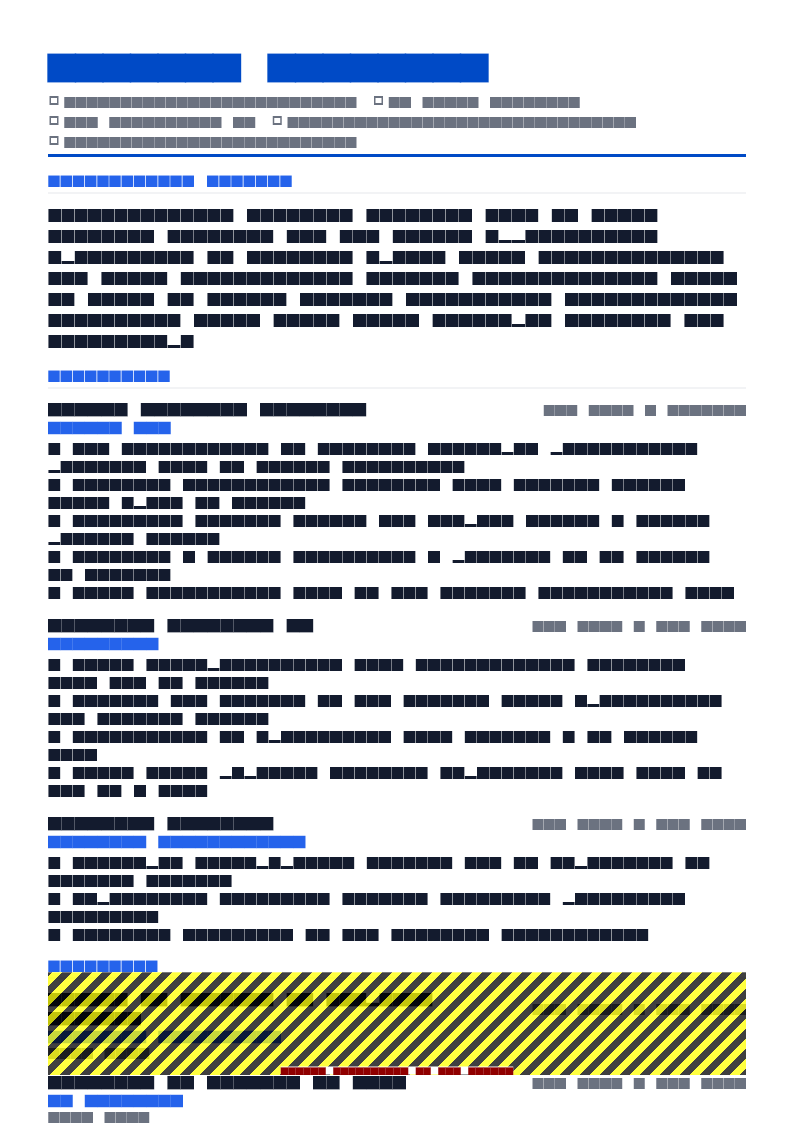
ATS Pro resume template
For hospital system portals, which are among the stricter parsers you will meet, ATS Pro is the safest choice: single column, conventional headings, and a licensure block that will not scramble. Free.
Use this template in NextCVTemplates and formatting for healthcare applications
Hospital systems commonly run large enterprise recruiting platforms, and their portals are among the stricter parsers you will meet. Single column, conventional headings, no tables. The full formatting rules are in the ATS resume tips guide; the short version is that a designed sidebar layout will scramble your licensure block, which is the worst possible section to lose.
From the NextCV template library, the layouts that suit a credential-heavy clinical resume:
| Template | ATS score | Best for |
|---|---|---|
| ATS Pro | 98 · Free | The safest choice for hospital portals — highest-parsing layout in the library |
| ATS Minimal | 96 | Two-page clinical histories where licence, certifications and units all need room |
| Pure White | 95 · Free | Experienced RNs who want a restrained, highly legible document |
| Skills Based | 85 · Free | Nurses re-entering practice or moving specialty, where competencies lead |
| Graduate ATS | 92 | New graduate nurses with rotations and a capstone rather than employment history |
Checklist before you apply
- Name line carries credentials in order — degree, licence, certifications
- Licensure block lists type, jurisdiction, status, expiry, and compact eligibility
- Every certification has an issuing body and an expiry date
- Licensure and certifications appear above work experience
- Each role has a unit descriptor: setting, bed count, ratio, acuity, EHR
- At least half your bullets end in a measurable clinical or quality result
- EHR systems named explicitly, with years where relevant
- Zero patient identifiers or identifiable case detail anywhere in the document
- Summary mirrors the posting's specialty and required certifications
- Single column, no tables, text-based PDF named
Firstname-Lastname-RN.pdf - Plain-text paste test passed — licensure block still intact
Frequently asked questions
How long should a nursing resume be?
One page for a new graduate, two pages for most experienced registered nurses, and longer only for advanced practice, academic or leadership roles where certifications, publications and committee work are genuinely part of the qualification.
Nursing is one of the few fields where a second page is expected rather than tolerated, because licensure, certifications, unit detail and clinical systems all have to fit alongside your employment history.
Should I put my nursing licence number on my resume?
Include the licence type, the issuing state or jurisdiction, and the expiry date — recruiters need those to confirm you are eligible for the role.
The licence number itself is optional: it is verifiable through public board registries, so listing it is common and not unsafe, but it adds nothing a recruiter cannot look up. A reasonable default is to list type, state and expiry on the resume and supply the number on the application form when it asks for it.
Where do certifications go on a nursing resume?
High — directly after your summary, before work experience. Certifications such as BLS, ACLS, PALS, CCRN or TNCC are frequently hard requirements, and recruiters filter on them.
Give the full name, the short form, the issuing body and the expiry date for each, so nobody has to guess whether yours is current.
How do I write a new graduate nurse resume with no experience?
You have more experience than you think — clinical rotations are experience. List each rotation with the unit type, the facility, the hours completed and what you did, using the same bullet structure as a paid role.
Put your licensure and certifications, education and clinical rotations above any unrelated employment, and lead the summary with your licence status, specialty interest and total clinical hours.
How should a travel nurse list assignments without looking like a job hopper?
Group them under the agency as a single employer, then list assignments as sub-entries with facility type, unit, city and dates.
That structure reads as one continuous role with multiple placements rather than eight short jobs, and it lets you show the range of units and EHR systems you have worked in — which is the actual selling point of travel experience.
Should I mention specific patients or cases on my resume?
Never. Do not include patient names, dates of birth, medical record numbers, room numbers, photographs, or any detail specific enough to identify an individual — that is a confidentiality breach, and a hiring manager who sees it will read it as a serious professional judgement problem.
Describe patient populations, acuity levels and volumes instead: "22-bed medical-surgical unit, 1:5 ratio, post-operative and telemetry patients".

NextCV Editorial
NextCV is an AI resume builder by Empire Softtech. We publish the same guidance our in-app ATS analyser is built on — seven weighted sections, 29 templates scored from 72 to 98, and no formatting advice we would not follow ourselves.