
The adjective problem
Customer service resumes contain more unverifiable claims per page than any other kind, and it is entirely unnecessary.
“Friendly, patient and passionate about helping customers, with excellent communication skills and a positive attitude.” Every applicant writes some version of this. None of it can be checked, and none of it distinguishes anyone.
Meanwhile, support is one of the most instrumented functions in any modern business. Your ticket volume, your CSAT, your first-response time, your resolution rate and your quality-assurance scores are all recorded — often on a dashboard you can see. A resume that ignores all of that in favour of adjectives is throwing away its strongest material.
Adjectives
Friendly and patient customer service professional with excellent communication skills, passionate about delivering outstanding service and resolving customer issues efficiently.
Metrics
Customer support specialist handling 90–110 tickets a day across email and chat at a 94% CSAT, with first-response time held under 40 minutes through two product launches.
Section order
- Contact
- Summary — volume, quality figure, channels, scope
- Skills and platforms — the helpdesk stack is a genuine keyword filter
- Experience — volume and quality metrics per role, plus what you improved
- Certifications and languages — languages are a real differentiator in support
- Education
Skills sit above experience because support recruiters search for platforms by name — Zendesk, Intercom, ServiceNow, Salesforce Service Cloud — and because onboarding cost differs sharply between someone who knows the tool and someone who does not.
The summary
Customer support specialist with 4 years in B2B SaaS, handling 90–110 tickets a day across email and chat at a 94% CSAT. Own the billing and integrations queues, and wrote 40 of the knowledge-base articles now deflecting roughly 15% of inbound volume.
Customer support team lead with 6 years in SaaS, currently managing 12 agents handling 4,500 tickets a month. Raised CSAT from 82% to 94% in three quarters by rebuilding the macro library and introducing weekly quality calibration.
Volume plus a quality figure is the minimum credible pairing. Volume alone invites the question of whether you were resolving anything; a quality score alone invites the question of how much you were handling.
The support metric menu
| Dimension | What to cite |
|---|---|
| Volume | Tickets, calls or chats per day, week or month; concurrent chats; accounts owned; contacts per agent |
| Quality | CSAT, NPS, quality-assurance or scorecard average, complaint rate, survey response volume |
| Speed | First-response time, average handle time, average resolution time, SLA attainment percentage |
| Effectiveness | First-contact resolution rate, escalation rate, reopen rate, backlog cleared, deflection through self-serve |
| Scope | Channels covered, languages, products or modules supported, shift pattern, time zones, on-call |
| Improvement | Macros or knowledge-base articles written, processes redesigned, agents trained, automation introduced |
| Commercial | Retention or saves, upsell attached to support conversations, renewal contribution |
The last two rows are where senior candidates separate themselves. Handling volume well is the job; reducing the volume that needs handling is what gets you promoted, and it is what a hiring manager for a lead role is looking for.
Where to find your numbers
Most support agents have access to more data than they realise. If you no longer have access, reconstruct honestly and use ranges rather than inventing precision.
- Your helpdesk dashboard. Zendesk, Intercom, Freshdesk and ServiceNow all expose per-agent volume, CSAT and response times.
- Your performance reviews and one-to-one notes. These usually contain the exact figures your manager was tracking.
- Quality-assurance scorecards. A QA average is a credible quality metric and few candidates cite it.
- Team dashboards and weekly reports. Useful for team-level context; be explicit about which figures are yours and which are the team’s.
- Rota and shift data. Establishes scale: shifts covered, hours, weekend and out-of-hours coverage.
“90–110 tickets a day” is honest and reads as someone who knows their own workload. A suspiciously exact figure you cannot substantiate will fall apart in an interview, where the standard follow-up is simply “how did you track that?”
Bullets that carry weight
- Cleared a 640-ticket backlog in six weeks while holding first-response time under 2 hours, by triaging into three severity queues and batching duplicate reports.
- Wrote 40 knowledge-base articles covering the top 12 recorded confusion points; self-serve deflection rose from 6% to roughly 15% of inbound volume.
- Rebuilt the macro library from 180 unmanaged snippets to 46 maintained templates, cutting average handle time from 9 to 6 minutes.
- Handled 30-plus escalations a month as the billing specialist, with a 3% reopen rate against a team average of 11%.
- Trained 6 new agents through a two-week onboarding I designed; all reached full queue independence within 4 weeks rather than the previous 7.
Three patterns worth copying from those. Pair a volume figure with a quality constraint — the backlog bullet is strong precisely because response time held. Compare against a team average where you have it, since 3% means nothing until the reader knows the norm was 11%. And name what you built, because artefacts survive you and hiring managers notice them.
Duty
Responded to customer enquiries by phone and email, resolved complaints and escalated issues where necessary.
Achievement
Resolved 4,500 tickets a quarter at 94% CSAT with a 78% first-contact resolution rate, escalating 9% against a team target of 15%.


Skills and platforms
- Helpdesk: Zendesk (Explore reporting, macros, triggers), Intercom, Freshdesk, Jira Service Management
- CRM & adjacent: Salesforce Service Cloud, HubSpot, ServiceNow, Confluence
- Channels: email, live chat (up to 3 concurrent), inbound and outbound voice, social, community forum
- Technical: SQL (read-only queries for account checks), API troubleshooting with Postman, browser dev tools, log reading
- Process: ticket triage and severity models, SLA management, escalation paths, quality calibration, knowledge-base authoring
- Languages: English (native), Spanish (professional working proficiency)
Two lines here do disproportionate work. Technical depth — even read-only SQL, Postman and log reading — separates you from the majority of the applicant pool and is the route to technical support and higher pay bands. And languages, which in support are a genuine, immediate business need rather than a nice-to-have. State proficiency honestly. Full lists in resume skills.
Call centre, retail, technical support and team lead
| Role | Lead with | Typical bullet shape |
|---|---|---|
| Call centre / contact centre | Calls per day, AHT, adherence, QA score, SLA | Handled 70–85 calls a day at a 6:40 average handle time with a 96% QA average and 98% schedule adherence. |
| Retail customer service | Customers per shift, transaction value, complaints resolved, upsell | Served 200+ customers per shift as keyholder, resolving 15–20 complaints a week with 4 escalations to management in a year. |
| Technical support | Tier level, systems supported, resolution depth, escalation rate | Owned Tier 2 escalations for the API and integrations queue, resolving 82% without engineering involvement. |
| SaaS / B2B support | Accounts owned, ARR supported, product areas, CSAT | Supported 140 accounts representing $8M ARR across billing and provisioning at 94% CSAT. |
| Team lead / supervisor | Agents managed, team metrics, coaching, ramp and attrition | Led 12 agents to a 94% CSAT and 92% SLA attainment; cut new-agent ramp from 7 to 4 weeks. |
| Support manager | Headcount, budget, tooling change, deflection strategy | Ran a 34-person function across 3 time zones; a self-serve programme cut contacts per customer 19% year on year. |
Your first support job
Support is one of the most accessible professional entry points, and hiring managers screen for three things rather than experience: can you write clearly, are you comfortable with software, and can you stay composed with an unhappy person.
Evidence for each, from whatever you have done:
- Written communication. Any writing you have done to a standard — a society newsletter, documentation, tutoring materials. The resume itself is also evidence, so it must be clean.
- Software comfort. Point-of-sale systems, booking platforms, a CRM you used in a part-time job, spreadsheets. Naming actual systems beats claiming to be a fast learner.
- Composure. Retail and hospitality supply this directly. Quantify it: complaints resolved, difficult situations handled, refunds authorised, shifts as the responsible person.
Handled 15–20 customer complaints a week as duty keyholder, authorising refunds up to £150 without manager approval and escalating 4 cases in 12 months.
More on reframing non-professional work in entry level resume.
Showing progression out of support
Many people use support as a way into a company rather than a destination, and the resume should support the next step. What travels well depends on where you are going:
| Target | Foreground from your support work |
|---|---|
| Technical support → engineering | Debugging depth, log analysis, scripts you wrote, tooling built, bugs you diagnosed to root cause |
| Support → customer success | Accounts owned, retention and saves, renewal conversations, onboarding delivered |
| Support → sales | Upsell attached to conversations, expansion identified, commercial discussions handled |
| Support → operations | Processes redesigned, automation introduced, reporting built, workflow ownership |
| Support → product | Feedback synthesis, top confusion points documented, features you argued for and their outcome |
| Support → QA | Reproduction steps quality, regression patterns spotted, test cases contributed |
In every case the strongest material is something you built rather than handled — a knowledge base, a triage model, a macro library, an onboarding programme. Those are artefacts, they outlast your tenure, and they are what makes a support background read as a foundation rather than a detour.
Templates
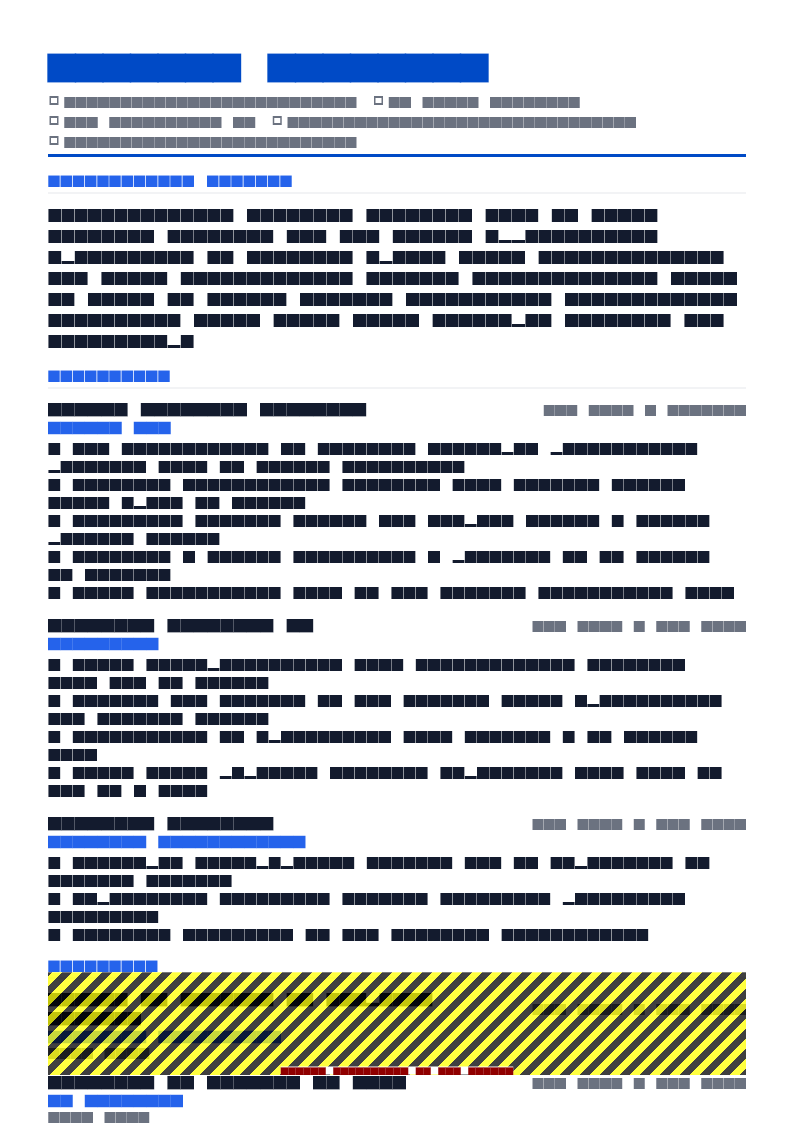
ATS Pro resume template
ATS Pro is the safest choice for high-volume support recruitment, where employers run large enterprise portals: single column, conventional headings, and room for a metric-dense experience section. ATS 98, free.
Use this template in NextCV| Template | ATS score | Price | Best for |
|---|---|---|---|
| ATS Pro | 98 | Free | The default — maximum parsing safety for large employer portals |
| Pure White | 95 | Free | Clean single page for individual contributor roles |
| Corporate Blue | 88 | Premium | Support managers with a two-page history |
| Campus Placement | 94 | Free | First support job, coming from study or part-time work |
| Skills Based | 85 | Free | Moving out of support into an adjacent function |
Checklist
- Summary pairs a volume figure with a quality figure
- Every role has volume, quality and speed metrics
- Ranges used where you cannot cite exact figures
- At least one metric compared against a team average or target
- At least one bullet naming something you built, not just handled
- Channels, products and languages stated
- Helpdesk platform named with depth (reporting, macros, triggers)
- Any technical skill — SQL, Postman, log reading — made visible
- No soft-skill adjective list
- One page, single column, text-based PDF
- The resume itself is clean, since writing quality is the job
Frequently asked questions
What should a customer service resume include?
A summary with volume and a satisfaction figure, then experience bullets built on ticket or call volume, CSAT or NPS, first-response and resolution times, and any process you improved. Then platforms, then education.
The differentiator is metrics. Support is measured continuously, so a resume without numbers reads as though the numbers were not good.
What metrics should I put on a customer service resume?
Volume (tickets, calls or chats per day, week or month), quality (CSAT, NPS, quality-assurance score), speed (first-response time, average handle time, resolution time), effectiveness (first-contact resolution, escalation rate, backlog cleared) and scope (channels, languages, products, team size).
Volume plus a quality figure is the minimum credible pairing, because either on its own can be gamed and hiring managers know it.
How do I write a customer service resume with no experience?
Use any role where you dealt with people to a standard: retail, hospitality, reception, volunteering, a society committee, or tutoring. Quantify it — customers served per shift, transaction value, complaints resolved, people trained.
Then add evidence of the specific things support hiring managers screen for: written communication, comfort with software, and the ability to stay calm with an unhappy person.
Should I list soft skills on a customer service resume?
Not as a list. “Excellent communication, patience and empathy” is claimed by every applicant and verified by none, and it wastes the space your metrics need.
Prove them instead: a de-escalation figure, a CSAT score, a knowledge-base article count, or a macro library you wrote all demonstrate those qualities without asserting them.
Is a customer service resume one page or two?
One page for most support roles, including team lead. Two pages only for support management with several roles and a broader remit.
Support hiring is high volume and fast, so a dense single page with visible numbers outperforms a longer document.
How do I move from customer service into another role?
Foreground the work that overlaps with your target. Support-to-technical means highlighting troubleshooting depth, tooling and any scripting; support-to-sales means retention, upsell and renewal conversations; support-to-operations means process and workflow improvements you owned.
In every case the strongest evidence is something you built rather than handled: a knowledge base, a macro library, a triage process, a training programme.
NextCV Editorial
NextCV is an AI resume builder by Empire Softtech. We publish the same guidance our in-app ATS analyser is built on — seven weighted sections, 29 templates scored from 72 to 98, and no formatting advice we would not follow ourselves.